

By Matthew Ehret


In Shakespeare’s famous play The Merchant of Venice, we are introduced to the strange character Shylock – a Jewish money lender living in the Venetian Republic who finds himself obsessed with revenge over the disrespect which he and his people have suffered at Christian hands for generations.
Shylock has internalized the rage and victimhood of his oppressed people to a toxic degree and becomes owned by the sense of resentment of having been used like a tool for the wealthy and powerful elite of Venice as a financier making loans at high interest.

In Shakespeare’s play, a moral but short-sighted Christian merchant and rival money lender by the name of Antonio wishes to assist his friend Bassanio by providing 3000 ducats to court a young noble heiress whom Bassanio adores by the name of Portia.
The Christian merchant believes himself to be wealthy with four vessels replete with goods scheduled to arrive home in the months ahead, yet he is also short of liquidity with all his wealth locked up in his overseas business ventures, and so thinks it no great danger to request a loan of Shylock saying:
“All my fortunes are at sea,
Neither have I money, nor commodity
To raise a present sum.
Therefore go forth —
Try what my credit can in Venice do.”
Shylock finally agrees after a period of negotiation… but only on condition that should the three thousand ducats not be repaid within an agreed-upon time span, then Antonio would have to pay him nothing short of a pound of his own flesh.Subscribe
Antonio thinks nothing of this strange contract, and since he is sure to come into great wealth shortly, commits to Shylock’s terms, setting the stage for the rest of the play.
As fate would have it, each of Antonio‘s three vessels sink at sea leaving the man poor and on the verge of bankruptcy with no means of paying his debt.
Rather than re-negotiate the loan, Shylock doubles down on his demands to see the contract honored and his pound of flesh carved out of Antonio even if it means the latter’s certain death.
Fortunately, by this time, Bassanio has successfully won the heart of Portia who has secretly found herself committed to saving the situation by secretly intervening into the life-threatening case. She does this first by using her family connections to speak with the Doge of Venice in order to plead Antonio’s case (and offer double the debt owed to Shylock). Secondly, and with the help of the Doge, she disguises herself as a legal expert to speak during Shylock’s court case against Antonio.
During the heated court case, Shylock rejects the disguised Portia’s offers to repay double, and even triple of Antonio’s debt in order to save the merchant’s life, obsessed with his pound of flesh, despite the fact that this will kill Antonio.
However, all is not lost.
Portia’s legal skills win the day, as she proclaims that Shylock may have his pound of flesh, but following the strict letter of the contractual law, is only permitted to cut out Antonio’s flesh, but not a drop of blood (as blood was not specifically included in the literal word of the contract).
Additionally, only one exact pound may be cut, but even a hair more will result in Shylock annulling the contract and instead losing everything he has for both not honoring a contract according to Venetian law and also threatening the life of a citizen.
By the end of the play, Shylock is forced to convert to his hated Christianity, and loses half of his possessions to the state, and the other half to Antonio (to hold only until Shylock’s death at which point the wealth will be given to Shylock’s estranged daughter).

Shakespeare’s Merchant of Venice was first performed in 1598 at London’s Globe Theater and like the earlier play The Jew of Malta featured an artistic rendering of the psychological archetypes shaping the forces of evil that had been incubating in Venice for centuries and which were then in the midst of infiltrating England. As the historian H. Graham Lowry has demonstrated in his seminal 1987 book How the Nation Was Won, the Venetian takeover of England which was begun in earnest amidst the reign of King Henry VIII and finalized with the 1714 death of Queen Anne was nothing short of a two century long coup d’etat which transformed the island nation into the seat of a maritime and banking empire.[1]
When the play was first performed, it was actually not known as The Merchant of Venice but rather as The Jew of Venice. This informal title echoed the famous play by Shakespeare’s contemporary playwright Christopher Marlowe titled The Jew of Malta first performed in 1591.
As will soon become evident, neither play was composed as a simple piece of entertainment but demonstrated the highest cultural intervention into an ancient evil with both historic and practical implications in the world in which both Marlowe and Shakespeare lived.[2]
The Geopolitics of The Jew of Malta
Christopher Marlowe’s earlier play features a Jewish merchant on the Island of Malta which, in reality, had become a seat of power of the Order of Knights Hospitaller since 1530 when the Island was given to the secretive and powerful chivalric order by the Hapsburg Empire on the condition that it be defended from invading Ottoman armies.
At this time, the Order of Knights Hospitaller, founded to oversee the Crusades in 1098, changed their name to ‘The Sovereign Order of Malta’, which it maintains to this day.
It is noteworthy that since the earliest days of the Crusades, both Malta and Venice had been gateways into North Africa and the Middle East and both served as a diplomatic, military and financial bridge of power deep into the kingdoms of the east and west alike.

Both Venice and Malta were also controlling hubs for the international slave trade.
As Shormishtha Panja writes in Marlowe and Shakespeare Cross Borders: Malta and Venice in the Early Modern World:
“Till the last day of the rule of the Knights, Malta was an important European refuge of slave traffic; slaves contributed to the economy of forced labour on Malta. The slaves were not just persons of colour or impoverished wanderers but whoever happened to be travelling in the captured vessel, whatever their race, religion, sex, or economic status”[3]


Over the course of two centuries of Crusades, the sister knighthoods of Templar knights (Poor Knights of Solomon’s Temple) and Hospitaller Knights of St. John of Jerusalem (who would later change their name to the Knights of Malta), would collaborate at times in co-managing the lucrative Crusades, while at other times, battled each other following rules of gangland warfare.
During the four Venetian vs Genoa wars that raged between 1256 and 1381, the Order of Knights Templar would find itself aligned consistently with Venice (until their 1314 demise) while their rival order of Knights Hospitaller would always ally with the City State of Genoa.
Even through both City States called themselves ‘republics’, in truth, they were anything but. Both were seats of vast imperial power and ancient evil with secret committees, occultism and disposable ‘doges’ enthroned at the top of an apparent hierarchy of power.
Long before getting adopted by England, the red cross of Saint George (flanked by two Griffons) would first be adopted by the republic of Genoa to celebrate the first Crusade in 1099 when the Kingdom of Jerusalem was established in Palestine.
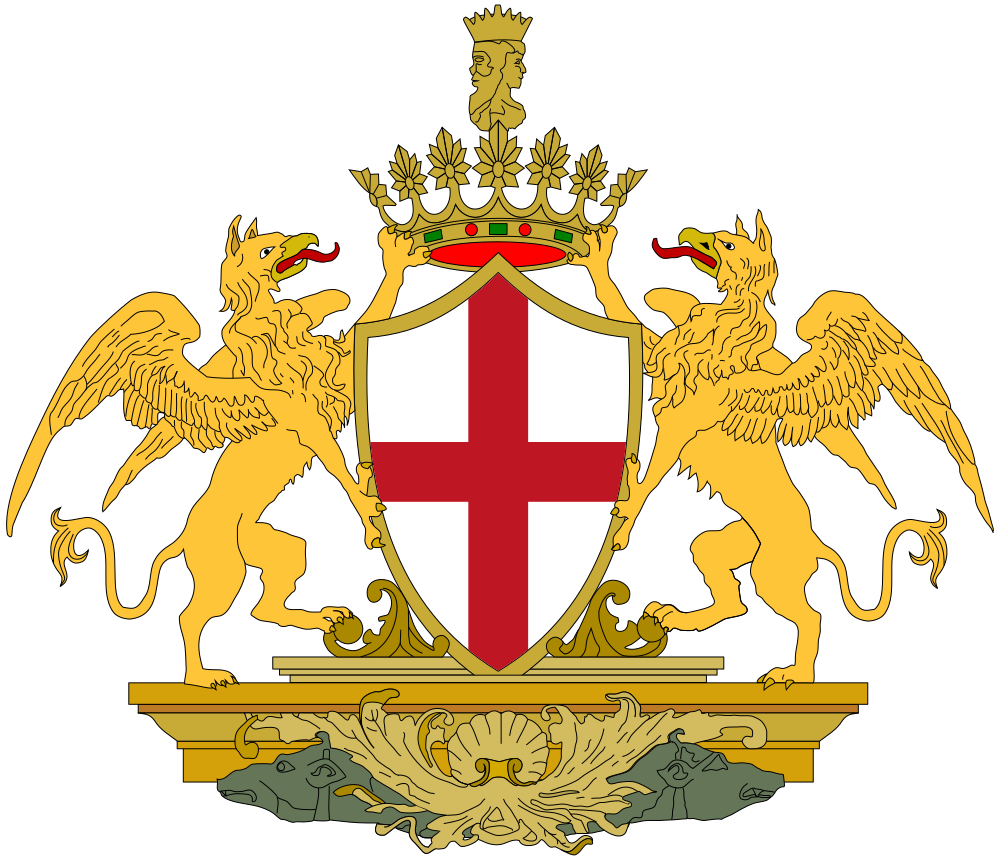
Since the Second Crusade in 1145, the Red Cross of St. George was used to symbolize the Knights Templar; and the Crusader King Richard the Lionheart who led the Third Crusade and collaborated closely with the Templars in Jerusalem would proclaim St. George as the icon of all crusaders.

It was only in 1348 that Saint George was adopted as the patron saint of England and commonly featured riding a horse while killing a dragon. This was done at the behest of King Edward III who had launched a secret society dubbed ‘The Order of the Garter’ and a new Crusade to take control of France which came to be known as ‘The Hundred Years’ War’.

The Order of the Garter would use the flag of St. George as the emblem for his new chivalric knighthood which would be overseen by a maximum of 26 members with the Prince of Whales and the ruling Monarch at the top of the hierarchy. Occult researcher Gerald Gardiner (the founder of modern Wicca) speculated that the 26 members indicated two witch covens.
The imagery of the garter itself, Gardiner speculates, was a signal used by witches and warlocks among the European Diana cultists that went underground 1000 years earlier and adopted such Christian cryptic motifs as the Black Madonna or the Cult of Mary Magdalene (the official saint of the Knights Templar).
The addition of the killing of the dragon was likely done as a way of infusing the Cult of Archangel Michael (featuring the image of an angel warrior killing a dragon) into Frankish Crusader kingdoms as a psychologically powerful organizing tool for the crusades.


The psychological usefulness of these two symbols is rather simple.
If a target population can be made to appear to be evil reptilian agents of Satan, then it becomes quite easy to induce Crusading Christian knights to recklessly kill and destroy this sub-human enemy (Jewish, Muslim or other).Subscribe
Although one may be quick to laugh at the susceptibility of superstitious medieval minds to ‘slaughter heathens for Jesus’, I advise you pause and think about the extremely large quantity of citizens in today’s world who have genuinely come to believe David Icke’s thesis that evil lizard aliens are running our world.
How many more steps are required for such beliefs to turn adherents into radical terrorists for Christ playing out the 1989 John Carpenter film ‘They Live’ starring WWF star Roddy Piper?

In 1818, the Order of St. Michael and St. George was established by the Prince of Wales in order to provide an honor system for the most devoted defenders of the British Empire, both within England and abroad. Among its recipients in recent times are former President George H. Bush and Henry Kissinger.

Amalfi and Malta
Beyond the rival republics of Venice and Genoa, a third powerful city state competed for power during these years of Crusades… Amalfi.
The City State of Amalfi was the most powerful maritime empire for several centuries before and during the Crusades and featured on its flag an image which we now recognize as the cross of the Sovereign Order of Knights of Malta.

Here is where it gets interesting.
During the 12-14th centuries, Malta was the producer of the best cotton of Europe as well as a strategic beachhead for the Crusades. It was also at this time that Malta was under the control of Genoa. The infrastructure established at this time was likely used by the early 16th century to turn Malta into the official seat of the Genoese-affiliated Knights Hospitaller which had been established to carry out the crusades in 1098 and which changed their name to the Order of Malta in 1530.

By the time Marlowe and Shakespeare would find themselves actively producing plays in England, Malta and Venice were the two dominant seats of oligarchist influence and ancient mystery cults.
Returning to the mind of Marlowe
In Marlowe’s Jew of Malta, the character Barabas is a wealthy Jewish merchant who similarly shares a dependent relationship with the Muslims and Christians living in Malta.

Like Shakespeare’s Shylock, Marlowe’s Barabas is consumed by rage and a sense of overbearing victimhood at the injustices suffered by the Jews in Malta, who had been degraded to the status of second-class citizens for centuries. The dramatic action that gives shape to this sense of rage takes the form of the confiscation of all of his properties by the Maltese Christian governor who seeks to pay tribute to the dangerous Muslims threatening to invade the island.
The character Barabas, like Shylock, are archetypes of a psychological profile of affluent Jewish Hofjuden (a medieval term referencing Court Jews) servants of oligarchical families akin to the very real Montefiore, Sassoon or Rothschild families.
The reason for this phenomenon of Court Jew, which began in a serious way amidst the courts of Europe during the Crusades, had much to do with the simple fact that Church law had forbade the use of money lending with interest. Yet for practical reasons of imperial control over target nations, the Templars, which had monopolized international finance until their powers were transferred over to the Order of Knights Hospitaller in 1314, needed to carry out usury while maintaining a Christian veneer.-
Thus, certain loyal Jews were given the tasks of money lending on behalf of their oligarchist masters. This was a practice which continued for the next thousand years.
Additionally, both characters feature daughters who become Christians to the horror of their fathers.
In the case of Barabas, rage turns into full blown evil more abrasively than the later case of Venice’s Shylock.
Barabas not only poisons his own daughter and the entire nunnery which his daughter moved into, but additionally kills his servant, his servant’s girlfriend and sets up the son of the Christian governor for a dual with another young Christian – both of whom are killed.
He additionally strangles a monk and frames an innocent victim to take the blame. His desire for vengeance against the Christians of Malta goes so far that he defects over to the invading Turks, becoming governor of the Island when the Turks take control.
By the end of the story, Barabas’ total nihilistic rage leads him to set a trap to induce the leaders of both Muslim and Christian worlds boil to death in a cauldron. At the last minute, Barabas is double crossed and falls into his own trap cursing those alive.
Throughout the play, Barabas has become an enemy not only to Christians and Muslims but also his own Jewish brethren, who suffer at his merciless hands.
Shakespeare is more subtle than the younger Marlowe, and is an expert of psychology, recognizing that the psycho-dynamic impulses that shape the distorted identities and behavior of the principal figures in his play are the consequence of toxicity, disrespect, bigotry, jealousy and other vices.
For instance, the hate which the Jew Shylock and the Christian Antonio feel for each other is visceral with Shylock stating: “I hate him for he is a Christian”. Yet Antonio, despite requesting a loan from Shylock arrogantly states: “I am as like to call thee so [dog] again, / To spit on thee again, to spurn thee too.”
In The Jew of Malta, a slight is given to both Jew and Christian when Barabas says: “Some Jews are wicked, as all Christians are.”
Despite showcasing the vile characteristics of the Hofjuden sociopath, Marlowe and Shakespeare cannot be labelled ‘proto-Nazis’ as many simple-minded critics have done over the years. In both cases, of The Jew of Malta and The Merchant of Venice, the evil carried out by the main Jewish character is not an emanation of the Jewish faith per se, but the reaction to the hypocrisy and injustice imposed onto those characters by Christian society.
By featuring ‘Christian’ knights of Malta, Catholic friars’ and ‘Christian’ merchants who are plagued by corruption, arrogance, and hypocrisy, Marlowe and Shakespeare are, in fact, intervening more heavily on their own principally Christian audience than many modern critics realize.
The similarities of the titles, themes of both plays indicate several things:
1) The fact that Shakespeare and Marlowe may possibly be the same individual as outlined by the work of Martin Sieff and Gerald Therrien represents a potent hypothesis that should not be overlooked.[4]
2) That both Malta- which had become the new seat of power of the Chivalric Order of Knights Hospitaller in 1530 which became renamed ‘The Sovereign Order of Malta’, and the “republic” of Venice, were centers of evil since the earliest days of the Crusades, and that this fact was understood by Marlowe and Shakespeare. Secret Societies organized around Chivalric initiatory orders were the principal conduit for court intrigue, espionage and power games across England, and many of those elements of power were exposed by Shakespeare and Marlowe.
3) That both the Orders of Malta (which gained control of the Templar banking, ports and many of their affluent holdings across Europe after the 1317 destruction of the Templar Knights), and the Kabbalist intelligence operations of Venice had been infiltrating the courts of England for nearly a century (since the untimely death of King Henry VII in 1509).
4) That the form of financial warfare used by Venice and Malta against the nations of Europe was dependent on the use of Hofjuden (aka: court Jews) expressed by the archetypal figures of Shylock in Shakespeare’s play and Barabas in Marlowe’s play.
Since ancient times, the Jews have suffered the manipulation of powerful occult forces and ruling families which has seen this people used as convenient magnets for hate at times, while a-moral members of the Jewish race have been selected to play the role of court financier in carrying out economic warfare on unsuspecting populations.
In the years following the untimely deaths of Marlowe and Shakespeare, new mercenary dynasties were brought into the upper courts of the old European noble houses to serve as weapons of war against humanity. Some of those nominally Jewish servants of empire had names like Sassoon, Castel, Kadouri, Bronfman, and Soros… However, most famous and most demonized among all of them is the name of Rothschild.
To understand the role of the Rothschilds as a powerful modern example of a Hofjuden dynasty at the service of a much higher power, I suggest you pick up a copy of Black Sun Rising, and/or watch the recent seminar which I recently hosted featuring researcher Mike King:

[1] This takeover is outlined in Gerald Rose’s The Venetian Takeover of England: A 200-Year Project, and Graham Lowry’s How The Venetian Virus Infected
and Took Over England – both 1994 studies published in Executive Intelligence Review.
[2] For an insightful study into the probability that both Marlowe and Shakespeare were, in fact, the same individual, see Gerald Therrien’s Spenser and Marlowe – God’s Spies published on The Rising Tide Foundation. (risingtidefoundation.net)
[3] Early Theatre 22.1 (2019), 71–92 https://doi.org/10.12745/et.22.1.3624
[4] Refer to Gerald Therrien’s RTF lecture “Marlowe vs. Francis Bacon – The Battle for Shakespeare’s Plays” here

You Think You Know All About WW2? Think Again: Get my new 200 page special report ‘Black Sun Rising: Esoteric Nazism Past and Present’


Black Magicians, Theosophists, Necromancers, Grail myths, Israel’s Templar origins, UFO cults, Aryan Venusian cosmic beings, Wall Street and London financiers, Gnostic orders, NATO secret armies, Maltese Knights, Kabbalists, Protocol forgeries, Odin cults and Green Berets.
Bio: I am the editor-in-chief of The Canadian Patriot Review, Senior Fellow of the American University in Moscow and Director of the Rising Tide Foundation. I’ve written the four volume Untold History of Canada series, four volume Clash of the Two Americas series, the Revenge of the Mystery Cult Trilogy and Science Unshackled: Restoring Causality to a World in Chaos. I am also co-host of the weekly Breaking History on Badlands Media and host of Pluralia Dialogos (which airs every second Sunday at 11am ET here).


