


By Matthew Ehret
Some readers of this Substack may have noticed an unfortunate but important dispute that has emerged between myself and Courtenay Turner a few weeks ago driven by the fact that we are using two very opposing philosophies. These two opposing philosophies are no small thing but represent whole world views representing what is knowledge, how is it developed, what is metaphysics and fundamentally what is God and the humanity made in the creator’s image?
This dispute over method and epistemology has confused a great number of people which is why I chose to write the following short essay on the question of Knowledge per se.
To restate our core difference: Courtenay has asserted her belief that Metaphysics (that is, the structure of reality dealing with purpose and permanent truths) and Epistemology (the study of methods of thinking about how the mind works), have zero connection. It also emerged that Courtenay has chosen to embrace Aristotle’s method which she has asserted to be the foundation for pretty much all progress including the American republic itself, while I, on the other hand have clearly sided with Plato.

Additionally, Courtenay has asserted that studying the minds of those who made discoveries of universal principles, and who used a Platonic method of thinking to see paradoxes and flaws in their own thinking which allowed a sense of learned ignorance, and thence discoveries of universal principles, is a trap set by gnostic magicians and should not be trusted (which I suppose includes myself).
In her latest public letter to me titled ‘Escaping the Wizard’s Circle’, she even went so far to assert that my promotion of Plato’s method is akin to having created a magical ‘Wizard’s circle’ entrapping credulous people who lack her understanding that Method of thinking and Metaphysics should be irreparably severed.
Apparently my affinity to Plato and his modern promoter Lyndon LaRouche has even earned me a place next to “the Bolshevik Central Committee, the Nazi Sicherheitsdienst, the Islamic Revolutionary Guard Council, the Chinese Communist Party’s Politburo Standing Committee” as Courtenay says “all of them claimed (and claim) proprietary access to a higher mode of knowing that justifies their rule over the unenlightened masses.”
Wow.
So either I am driven by a duplicitous agenda to trap suckers into my Nazi Bolshevik gnostic Wizard circle in order to defend all things China, Russia or Multipolar which Courtenay also publicly stated in her report… OR MAYBE I am genuinely morally sickened by the Jesuitical imposition of a divide severing HOW we think and WHAT ideas about Metaphysics we chose to adopt and live by.
Is it possible that I am actually concerned that the imposition of this division is going to get us all enslaved and murdered?
Discoveries are a Universal Human Right
I would like to here respond by stating my belief that discoveries which transcend memorizing expert opinions or playing with pattern-driven thinking, are a universal right of all people.
This also means that if we have strong opinions about a Metaphysical structure shaping reality, then we should be able to justify how we came to draw those conclusions we have SINCE NOT ALL CONCEPTS OF METAPHYSICS ARE THE SAME.

If not all ideas of metaphysics are the same, then what makes one person’s idea of metaphysics superior or inferior to someone else’s? Is there no way to know?
Should this question be outside the bounds of inquiry?
Or should we simply not be responsible for justifying how we came to adopt our beliefs… metaphysical, moral or otherwise?
Is saying “my metaphysical beliefs are the product of simple common sense” an adequate standard of claiming knowledge?
To Restate: Discoveries of the Platonic variety with which I engage and strive to teach others to develop is universally accessible and most natural to all humanity without exception. But it requires some free will, humility to question or abandon false axioms, and stamina. The method which allows these potential discoveries to be actualized are not esoteric, secret, elite but the right of everyone to experience themselves.
The short clip by Lyndon LaRouche from 1994 elaborates upon this philosophy of discoveries beautifully. (The full speech featuring an introduction by Martin Luther King’s close ally Amelia Boynton Robinson can be viewed here)
Was LaRouche pulling our legs in order to trap credulous listeners into a Hermetic Kaballist Wizard’s Circle?
Or is there something to what he is saying?
The Case of Children
The act of discoveries and more importantly learning to think about thinking itself is something children of all cultures and time periods organically do by finding passion to solve simple problems and engage in trial and error hypothesizing when figuring out language, walking or any new skill. It is tied to a play instinct and an internal drive that is absolutely divine.

That wonder and humility and passion to go beyond limits and learn new things which the ignorant self was incapable of is a natural thing which only gets trained out children during conditions of social imperial corruption.
When the mind becomes increasingly capable of working the non-physical (ie: Metaphysical) muscles of self-conscious reasoning (i.e. the art of hypothesizing, Higher Hypothesizing and improving our thinking about thinking itself), then this process becomes even more pronounced as we age, and the passion/appetite to seek those higher pleasures of the mind are also enhanced in turn. But it is all part of the same natural process encountered by the creative growth of young children.
What Learning Isn’t
It is not mere Aristotelian mimicry (mimesis) or habituation (Aristotle’s ethos), or even Aristotle’s false definition of reason (i.e. syllogisms based on a priori rigid definitions to be memorized but never questioned or truly discovered)…
Those are superficial features to the true learning process which perhaps some Aristotelians would say is happening inside the tabula rasa of a young child being programmed how to be human. Information ‘going into’ our minds using mimicry, habit and tautalogical logic would be the definition of education to such an Aristotelian.
I totally deny that true human ‘learning’ is defined by putting things ‘into’ any vessel or mimicry, but is actually like Plato states: like lighting a flame within by awakening potential… And I further assert that the child is actually hypothesizing (i.e.: generating new hypotheses) and learning to self-reflect on wrong hypotheses as the causal thrust of the early un-formalized learning process.
Continuing to do this as we age with ever-more matured cognitive faculties is what Plato teaches throughout his works and is entirely absent from Aristotle who prefers learning be defined to habit formation, mimicry, memorizing definitions of unassailable axioms, and practicing rules of syllogistic logic. There are unquestionably many nice words that Aristotle uses along this pathway such as ‘virtue’, or ‘reason’ or ‘universal principles’… but if he promotes a method that demands we limit our concept of learning to ‘habit formation, mimicry, memorizing definitions of unassailable axioms bounded by syllogistic logic’, then is Aristotle promoting truth or sophistry (ie: the surface appearance of truth devoid of the substance)?
Yes Aristotle says nice things about rights and freedom in some places within his texts, but his system is grounded in root axioms that shape the terrain and which render impotent and hollow those nice things he says. If he didn’t believe that slavery was necessary, then why did he need to codify it as a universal law?
Was he being ironic?
No Aristotle doesn’t believe in irony. That’s why he berates Plato who believes that irony and ambiguity is the only key to making discoveries. Aristotle, on the other hand, believes truth is literal, static, and accessible via closed crystallized definitions. So he is merely setting the stage for a system based in self-contradiction, and honestly a bad defense of truth is more damaging than a full attack on it.
This is the essence of sophistry in all forms and it is extremly ironic that Aristotle’s philosophy hinges on his “Principle of Non-Contradiction’… which betrays the fact that his own philosophy is rooted on an edifice of contradictions.
If he knew how to examine his own axioms, and identify ontological paradoxes in his own thinking, he would find that very funny.
De-Mystifying “Epistemology”
To restate: That method advanced by Plato, Cusa, Poe, Leibniz, LaRouche, and to which I am devoted is universal and not reserved for an inner elite. It is also not based on any reliance on authority or blind assumptions, or the product of popular opinion or lazy unthinking ‘common sense’ acceptance of “Being”.
Everyone- not just an “initiated elite” can discover universal principles- both moral and physical which are not treated as separate but co-existing in one universe.
This is the purpose of Plato’s dialogues which never give a finalized closed answer the way Aristotle and his followers are prone to do because Plato actually cares about your mind’s right to think for itself and work through problems.
Rather than providing a finished crystalized set of definitions about Justice, virtue, freedom etc the way Aristotle does, Plato instead teaches (via such examples as the Meno Dialogue) that EVERYONE can make discoveries. Even children born into slavery such as Meno’s slave boy. The fact that Aristotle has so much vitriol for Plato’s demonstration of the self-taught slave child says a lot about Aristotle’s true heart in my view.
So even though this is not gnostic, and is available to everyone, it does require the cultivation of a mental muscle that is based upon the breaking free of the limits of either inductive or deductive reasoning (while not abandoning them wholesale) by learning how to:
- Always get better at self-examining our root axioms
- Recognizing how the entire system of logic that we generate about the universe (physical and metaphysical) is influenced causally by our root axioms (which should be better treated as hypotheses instead of unassailable assumptions) and
- Identifying that the paradoxes we encounter when trying to discover something ontologically true about the world we are created into are caused not by the universe itself being inherently ontologically paradoxical or absurd, but rather it is the ontological reality of our own active mind when governed by false hypotheses which generates the ontological paradoxes.
Kepler’s Ontological Paradox
This is what Johannes Kepler demonstrates in theory and practice through his Vicarious Hypothesis which took five years of his life and which occupies the first seven chapters of his 1609 New Astronomy.
Throughout these chapters of a book which literally created a revolutionary new physical science of Astronomy and established Kepler’s first two laws (of three) laws of planetary motion, Kepler generated a profound Ontological Paradox that was irreconcilable with the core shared root axioms of all standard model explanatory systems of astronomy of his day.
I go through the essentials of Kepler’s discovery and vicarious hypothesis in the following lecture ‘Reviving the Lost Art of Pythagorean Thinking (start at minute 1:51:12)
Lavoisier’s Ontological Paradox
Additionally, the great French Platonist, and Chemist Antoine Lavoisier (1743-1794) does this in his discovery of oxygen by reviewing the paradox formed when he realized that rusted iron weighed MORE and not LESS than un-rusted iron, despite visually APPEARING to have become less in mass than the original un-rusted iron subjected to water for a long period.
Lavoisier thus realized that despite the fact that EVERY modern scientist had to pay homage to this mysterious invisible substance dubbed ‘Phlogiston’, which was assumed to exit iron as it rusted, the increased weight of rusted iron implied the entry of a new substance. That substance became known as ‘Oxygen’.

This was an ontologogical paradox, akin to Kepler’s Vicarious Hypothesis of 1605.
This ontological paradox involves the creation of a state of perplexity which liberates the mature mind from the shackles of false axioms (false hypotheses) and opens the door to the generation of new eurekas that resolved the paradox as demonstrated by Lavoisier himself.
Some might assert that this is a slight of hand designed to subvert ontological truth by replacing objective reality with subjective reality. Those who say this would be entirely mistaken, and would ironically have adopted a false neo-Platonist controlled dialectic akin to the dialectic promoted by Hegel or Marx which denies all examination of actual discoveries of principles made by healthy individuals throughout history. What proof do I have for this claim?
Simply the direct evidence available in the original writings of all of those minds who make discoveries of universals which all draw from the same well that necessitates 1) the ‘seeing’ of ONTOLOGICAL PARADOXES, 2) embracing the discomfort of being in unknown waters, 3) having the faith in themselves and the rational goodness of the Creator to 4) generate solution concepts from within their own subjective minds which harmonizes with the objective Truth shaping that universe which they are yearning to discover.
If God has love for each of us, and is truly the best, most good, and most reasonable essence shaping all of reality, including humanity, then that purposefulness, love and intention shaping Creation may not simply be purely an objective phenomenon as we have been led to believe.
Case Study: Dimitry Mendeleyev
Following Lavoisier, the Russian chemist Dimitry Mendeleyev (1834-1907) also generated his insight into the periodic ordering of the elements which profoundly transformed humanity’s potential, increased our carrying capacity and resonance with the universe in 1869. What is perhaps most startling, is that he made his discovery without knowledge of electrons (which would only be discovered 40 years later).
So, how did he do it?
You would need to read the original text of his Principles of Chemistry, but he tells you. And spoiler alert, it is not dissimilar from the Platonic method used by Kepler and Lavoisier earlier and entirely involved the “seeing” ontological paradoxes with the mind’s eye and then generating higher hypotheses that would resolve the paradoxes.

The concordant POWER to see and thus act upon the future was showcased by Mendeleyev’s successful prediction of no less than SEVEN unknown elements. He even described where they would be located on his periodic table including their properties. Despite being treated as a crazy person, over the ensuing years, Mendeleyev was validated as gallium, scandium, and germanium, technetium, rhenium, polonium, and francium were discovered exactly where he said they would be.
Mendeleyeev was not a Neo-Platonist, or gnostic magician. He was a Platonist and Leibnizian and this discovery (along with its predictive power and method) was proof that both Plato’s proof of the Immortality of the Soul contained in the Meno Dialogue and Leibniz’s Principle of Pre-Existent Harmony were true. The fact that Leibniz developed that principle from his studies of both Plato’s Meno and Phaedo dialogue (as outlined in his famous 1686 Discourses on Metaphysics) should not be discarded.
Case Study: Gottfried Leibniz
Throughout his life Gottfried Leibniz (1646-1716) mastered the Platonic method and honed the art of self examining Ontological Paradoxes (while battling Hermetic Kabbalists, radical empiricists and Scholastic Aristotelians alike).
Leibniz not only made universal discoveries beyond even the Infinitesimal Calculus for which he is most famous, but generated the field of economic science which LaRouche has explained formed the backbone of his later contributions to the Science of Physical Economy. This is not esoteric for either man as they provide step-by-step explanations of their own minds replicable for anyone who reads their actual writings instead of relying on dishonest ‘authorities’ telling us how to think about these men.
See for example, among the hundreds of writings, LaRouche’s 1984 textbook ‘So You Wish to Learn All About Economics’ and see if I am lying.
Leibniz also was a statesman of the highest order and established revolutions in mining, machine tool development, practical inventions, the steam engine, and the creation of academies of sciences and the arts around the world.


Leibniz: Scientist, Sinophile and Bridge Between East and West
·
July 15, 2021
Leibniz was in direct communication with John Winthrop Jr. and earlier Puritan Platonists in Massachusetts and his philosophy of Happiness (On Felicitiy) and international law shaped the great jurist/statesman Emmerich de Vatel and leading figures such as Ben Franklin who ensured Vatel’s writings were circulated throughout the USA.
Leibniz also wrote in Platonic dialogues, directly praised Plato as superior to Aristotle, and generated an advanced system of metaphysics based on his discoveries of universal principles outlined in his Discourses on Metaphysics (of which I have taught several workshops available here along with the original text).
How did Leibniz engage with Ontological paradoxes?
We can easily find out since he made his method public in the publication ‘The Acta Eruditorum’.
Unlike Newton who appears to have been a Rosicrucian plagiarist in the Invisible College and was never able to regenerate this work to showcase how he made his supposedly brilliant discoveries, the case is different with Leibniz.
The paradox Leibniz dealt with which generated his ontological paradox was essentially the following:
All figures of authority in the 17th century asserted lazily that the physical curvature caused by hanging chains or rope bridges can only be examined with Parabolic functions. Galileo, Descartes and other high priests shaping standard model behavior asserted that no other path existed and since hanging chains (aka: Catenaries) looked a lot like parabolas, that we could treat them ontologically like parabolas. That bubbles which took the form of spheres, could be investigated with spherical functions.

Leibniz was much more honest than these ‘authorities’ of his day, and recognized that parabolas were merely a Euclidean abstract entity devoid of any physical principles, whereas Catenaries were shaped entirely by forces of gravity, and infinitesimally changing dynamics of ratios of horizontal and vertical tension. Simply fudging data by using euclidean math would would not work to crack this problem.
So how could it be solved?
Leibniz took up the challenge first laid down by Johannes Kepler in 1609 who called for the invention of a language that could describe the non-linear rates of change encountered in physical reality (in Kepler’s case the shapes in question were his newly discovered elliptical orbits which involved changing rates of speed and distance of planets from the motive power AT EVERY INFINITESIMAL instance, but which Kepler did not yet have a language to describe.

Life or Death: Which Law Governs the Universe Part 2: Locke and Newton vs Leibniz
·
November 10, 2022
Using actual hanging chains, Leibniz developed the Infinitesimal Calculus using concrete experiments which any child can play with and which generate a vast array of Ontological Paradoxes needed to discover why the calculus works. If you did not get introduced to that form of the Infinitesimal Calculus in school, or if you were told that BOTH Newton AND Leibniz co-discovered the Calculus together, you have been victimized by the oligarchy. Don’t fret, with knowledge of how you were robbed of this discovery, you can now recapture it yourself.
Read Leibniz and the work of modern Leibnizians such as Ernest Shapiro to find out how you can do it.
Even modern mainstream mathematicians who pay homage to the ‘Great Genius Isaac Newton’ have to admit that Newton’s version of the calculus (which relied on imposing infinitely divisible minute fragments onto curvature dubbed ‘Fluxions’) has NO practical value in modern science, while Leibniz’s notation still finds use across all domains of science without exception.
The Implications of Discoveries and Potential to Develop our Minds
I could go on and demonstrate MANY more examples by showcasing the minds of discoverers throughout history including Max Planck, Marie Curie, Vladimir Vernadsky, Alexander Gurwitch, Fritz Albert Popp, Halton Arp, Wilhelm Weber, Carl Gauss, Bernard Riemann, Christian Huygens, Pierre Fermat (to name just a few), but it suffices to say that it is not esoteric, and if you want to do any sort of genuine problem solving that establishes real knowledge as something qualitatively apart from mere “right opinion”, or ‘belief in being’, then these qualities of thinking will have to be involved.
Many more case studies are featured in my 2023 book ‘Science Unshackled: Restoring Causality to a World of Chaos’.
‘Science Unshackled’ Group Review with the Holmes Family
·
December 12, 2023

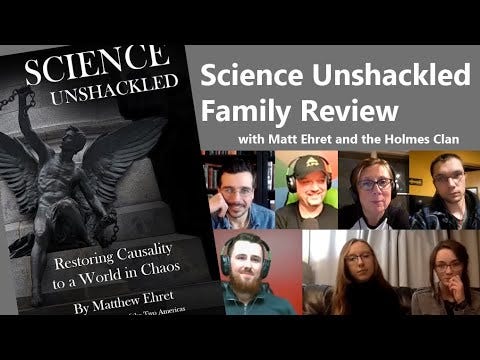
This week, I had a fun time chatting with Mike, Noelle, Madison, MayCee, Sebastien and Kyle (of the Holmes family of Alberta) about their thoughts about science, cognition, misinformation, truth, lies, beauty and Goodness during this group review of my new book
Anyone trying to solve a constructive geometric problem or any serious topic involving universals must go through this process.
Otherwise the category of ideas that one generates about any topic relating to universals (which is the basis of any healthy metaphysics worthy of the name) is not going to be grounded on anything real.
It may be the effect of memorization of a formula or copying from someone else, and it will produce a conviction inside your heart… but it will not be true knowledge.
But don’t take my word for any of this.
Try it out for yourself… Try to figure out how to divide a circle into five equal parts.
Try to double a square in area and identity (from a square of area 1 into a square of area 2).
Try to prove why the Pythagorean Theorum is true without using any formulas or math.
Try to divide a circle into three or four equal sections using only rotational action of a compass.
Once you do that, divide a string by three or four or five and see if you can hear the sound of a pentagon, square, or triangle
Try to calculate the circumference of the earth using only a shadow cast by two poles in two locations.

If you tried to solve these fun problems by reading a wikipedia entry, asking Chat GPT or going to the back of the text book, you might pass a formal school test, but you would fail at generating real knowledge.
Aristotle might approve of what you did, but Plato would not.
All you would be left with is memorization supported by syllogistic logic that is itself rooted in tautologies (circular logic) and axioms which we believe to be true but cannot prove more deeply, or inversely patterns of experience we extrapolate into generalizations a la Francis Bacon or some syncretization of the two paths as was done by Gnostic agents such as Rene Descartes, George Hegel and Emmanuel Kant.
But again, this is not specifically human thinking.
This is literally the foundation of the programming of all computer languages (enmeshed with a little training of monkeys for good measure).
Or maybe I’m just saying all of these things to entrap gullible people into a magical Wizard’s Circle using the evil black magic of ‘dialectics’.
If you want to dig into these ideas further, consider looking into the following material:


Follow my work on Telegram at: T.me/CanadianPatriotPress
I am the editor-in-chief of The Canadian Patriot Review, Senior Fellow of the American University in Moscow and Director of the Rising Tide Foundation. I have written the four volume Untold History of Canada series, four volume Clash of the Two Americas series, the Revenge of the Mystery Cult Trilogy and Science Unshackled: Restoring Causality to a World in Chaos. I am also co-host of the weekly Breaking History on Badlands Media and host of Pluralia Dialogos (which airs every second Sunday at 11am ET here).