


By Dimitri Lascaris
From the outset of Russia’s special military operation in Ukraine, four of the five political parties in Canada’s Parliament have supported the transfer of lethal aid to Ukraine. Until now, the only opponent of lethal aid was the Green Party of Canada (GPC).
The GPC expressed its unequivocal opposition to weapons transfers in three statements issued in early 2022. (At that time, the party was led, on an interim basis, by Amita Kuttner.)
First, on January 31, 2022, the party issued a statement in which it declared that the GPC “strongly opposes any Canadian military involvement in Ukraine and the export of weapons to this conflict zone” [emphasis added].
Then, on February 24, 2022, the GPC issued a press release in which it stated:
The Green Party is calling on the Canadian government to use every available non-violent tool to punish and isolate Russia for its criminal decision to attack Ukraine.[…]
The Green Party stands with the people of Ukraine during this dark time and wholeheartedly supports all Canadian initiatives to provide humanitarian and other non-military aid.[Emphasis added.]
Finally, on March 8, 2022, the GPC issued another statement in which it reiterated that:
The Green Party does not support arms exports to Ukraine, the deployment of NATO forces in Ukraine or the unilateral creation of a no-fly-zone. This can only be done through agreement at the United Nations. NATO is a defensive alliance and its direct involvement would only lead to an expansion of this war. The threat of nuclear war hangs over the whole world.[Emphasis added.]
Nine months later, in November 2022, Elizabeth May won the GPC’s leadership contest. She prevailed with 4,666 votes. This constituted 39% of the 12,090 votes with which Annamie Paul had won the GPC leadership contest in 2020. (In the interest of full disclosure, I myself ran and finished second, with 10,871 votes, in the GPC’s 2020 leadership contest.)
May returned to the leadership after having served for thirteen years (from 2006-2019) as GPC leader. During that period, the GPC never held more than 3 seats, which constitutes less than 1% of the seats in Canada’s Parliament.
Since returning to the GPC leadership, May has wasted no time in reversing the GPC’s opposition to lethal aid for Ukraine.
Her abandonment of the GPC’s pacifist stance emerged in a GPC press conference held on January 31, 2023. This profound change in party policy was revealed in response to persistent questioning from David Thurton of the CBC, Canada’s national broadcaster. Below, I reproduce the full exchange between Thurton, May and the GPC’s deputy leader, Jonathan Pedneault:
- David Thurton (DT): Can I ask a question about the war in Ukraine? We’ve seen the evolution of the Liberal’s policy when it comes to lethal aid. We’ve also seen certainly the NDP move on this. Has the Green Party of Canada’s policy in any way changed when it comes to supporting lethal aid, supporting maybe, you know, well sending more tanks, maybe even fighter jets.
- Jonathan Pedneault (JP): The Green Party understands the complexity of the situation in Ukraine. I was myself in Ukraine during the first ten days of the conflict, reported on human rights violations, violations of the laws of war by Russia. Russia has invaded illegally the territory of Ukraine in 2014 and has continued that invasion further and further since last year. It’s crucial that Canada not only supports our Canadian colleagues and friends but also seeks to develop strong diplomatic solutions to that crisis. We know that there is no end to this conflict through armed ways. It’s crucial that Russia not only stops its invasion and stops any form of violations of the laws of war that is ongoing currently in Ukraine and we believe that Canada needs to double down on opening ways, diplomatic channels to try and seek a diplomatic solution.
- DT: But do you support sending lethal weapons. Is that something that the Green Party now supports?
- JP: The Green Party is a party that believes in peaceful resolution to conflicts. We believe that it would be much more appropriate for Canada to invest in its diplomacy which has been severely undercut during the Harper years and not quite rebuilt during the Liberal years, despite claims by Prime Minister Trudeau that Canada is back.
- DT: But you can do that and still send weapons, right?
- Elizabeth May (EM): Just to speak to this. I asked Jonathan to take the first round on that because of course he has intimate personal knowledge as he mentioned having been in Ukraine at the beginning of the conflict. We also are a party that’s global. We are members of the Global Greens. The Minister of Foreign Affairs of Germany, Annalea Baerbock, is former co-leader of the German Green Party… The Greens have been going through globally, whether Greens in Sweden, Greens in Finland, where they’re in government…, we also work collegially with Global Greens, and there are Greens in Ukraine, the Green Party of Ukraine, as I said in my speech in response to President Zelensky’s speech in Parliament, an extraordinary moment last year, the Greens in Ukraine are begging us to help them have more defences and even engage in air-wars over Ukrainian territory in order to create a no-fly zone. We can’t support that. Those measures that are defensive, we will support. We have to stand in solidarity with the peoples of Ukraine but also for, and we try to work in coalition with other countries where Greens are in government. We consult frequently, and for that reason, we are not opposing what our government has done thus far, but I can’t underscore enough, there are opportunities, I believe and Greens believe, for diplomatic solutions, particularly for a cease-fire, as soon as possible, and some of those are unexplored. I’ll mention one. It’s a problematic political situation in Israel right now, for obvious reasons, but Israel, basically, is the only democracy ally in the industrialized world that has not done a single thing in terms of sanctions against Russia. Netanyahu is close to Putin. There’s an opportunity there, I believe, to put pressure on our ally Israel to put pressure on their ally, Russia, in order to open up peace talks. And it was actually President Zelensky who first said, I think it was March of last year, that there should be peace talks, and he then called out to the previous Prime Minister of Israel to offer peace talks in Jerusalem as a way to see people brought to the table. I mean Israel’s historic connection to Putin is because Israel needs Putin’s help to get the butcher of Baghdad Bashar al-Assad’s permission to have Israeli planes flying over Syrian airspace to bomb Hezbollah targets. [May seems to be confusing Syrian President Bashar al-Assad with Saddam Hussein. Baghdad is in Iraq, not Syria, and the “butcher of Baghdad” refers to Hussein, not Assad.] That’s why Israel is close to Putin. But there are a lot of Israeli-Russian joint citizens who fall into the category of oligarchs. Israel should step up in this situation. That’s just one example, where could we —
- DT: In Green Party policy, where previously my understanding you opposed lethal aid but it sounds like you support the measures taken —
- EM: Any measures that is purely in, sorry, defensive efforts, but as Jonathan has said we recognize and we want to —
- DT: Isn’t that a change?
- EM: No it’s not a change. We’re recognizing very clearly that, in this context, this cannot be won militarily. We want a free, democratic, safe Ukraine. That means the war has to stop. We do not believe the war will come to an end through a military victory for either side. We think it’s imperative that the killing stop, that the violations of human rights stop, and we think the efforts should concentrate less on weapons and more on pushing for peace talks.
One striking aspect of this exchange is that neither May nor Pedneault explicitly answered Thurton’s question as to whether the GPC supports the delivery of tanks or fighter jets to Ukraine. Although May eventually confirmed that the GPC supports “defensive” measures, she did not state whether she considers tanks or fighter jets to be “defensive”.
Whatever one may think about the wisdom of sending tanks or fighter jets to Ukraine, we should all be able to agree that the public deserves straight answers on matters of public policy – particularly when those policies involve military conflict with a nuclear-armed state. Elizabeth May has long claimed that the GPC ‘does politics differently’. Her evasiveness, however, is all-too-reminiscent of the prevailing, cynical politics.
So too is her dubious claim that the position she articulated in her January 31 press conference does not constitute a change in GPC policy toward arming Ukraine. As explained above, in early 2022, the GPC issued no less than three statements in which it unambiguously opposed weapons exports to Ukraine. In her press conference, however, May stated that “we are not opposing what our government has done thus far.”
Here is what the Canadian government has done “thus far”: from January 24, 2022 to November 20, 2022, the Canadian government provided approximately $1 billion in military aid to Ukraine, making it the fifth largest donor of military aid to Ukraine globally:

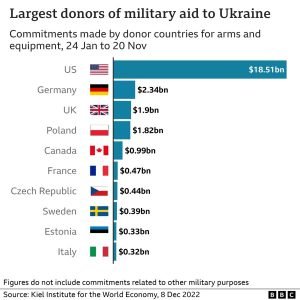
According to Canada’s Department of Defence, that military aid included machine guns, pistols, 1.5 million rounds of ammunition, sniper rifles, 100 anti-armour weapons systems, 4500 M72 rocket launchers, up to 7500 hand grenades, an undisclosed number of M777 howitzers and associated ammunition, and 20,000 artillery rounds of 155 mm NATO standard ammunition.
In addition, in January 2023 – before the GPC press conference of January 31, 2023 – the Canadian government announced that it would provide to Ukraine a National Advanced Surface-to-Air Missile System (NASAMS) and associated munitions, as well as 200 Senator Armoured Personnel Carriers and four Leopard 2 main battle tanks.
The logical inference to draw from May’s statement that “we are not opposing what our government has done thus far” is that the GPC does not oppose the delivery of any of these weapons, including Leopard 2 tanks, to Ukraine, How can May assert with a straight face that that position does not constitute a change from the GPC’s statements, one year earlier, that it “strongly opposes… the export of weapons to this conflict zone”?
The result of this change in the GPC’s stance is that no party in Canada’s Parliament now opposes the transfer of weapons to Ukraine.A poll conducted shortly after Russia’s SMO began found that nearly 3 in 10 Canadians did not support the delivery of weapons to Ukraine. Who now speaks for these Canadians in the Parliament of Canada? Do they not deserve a voice in this vitally important debate?
Again, whatever one may think of the wisdom of sending tanks or fighter jets to Ukraine, the absence of dissenting voices in Canada’s Parliament should trouble us all. In matters of war and peace, the public would best be served by vigorous Parliamentary debate on this critically important issue. Marching in lockstep toward war with a nuclear-armed state, and silencing the millions of Canadians who oppose lethal aid to Ukraine, simply cannot be in the national interest, nor can it be consistent with democratic principles.
Quite apart from these considerations, May’s commentary suggests a questionable grasp of geopolitical realities.
In particular, in the context of this war, the distinction between “defensive” and “offensive” weapons, whatever those terms may mean, is meaningless. Presumably, May seeks to confine the GPC’s support to “defensive” weapons because she is concerned (with complete justification) that the transfer of “offensive” weaponry to Ukraine could provoke Russia to escalate the conflict, with potentially catastrophic consequences for humanity. If that is indeed her concern, then the operative question is not whether our side regards a particular weapon as “offensive”, but whether the Russian side regards a particular weapon as “offensive”.
In that regard, it is vital to understand that Russia has adopted legislation incorporating into the Russian Federation not only Crimea, but also the four eastern Ukrainian oblasts of Luhansk, Donetsk, Zaporizhia and Kherson. It is in these four oblasts and in Crimea where Russia’s combat forces are concentrated. From the perspective of Russia’s government, attacks on Russian troops that are situated in these areas are attacks on Russian territory, and any weapons used to attack those troops – for example, howitzers, machine guns, armoured personnel carriers and tanks – could well be viewed by Russia’s government as “offensive”.
From the standpoint of human survival, it is irrelevant whether Western governments are correct that the annexed territories remain part of Ukraine and that attacks on Russian troops stationed on those territories are “defensive” measures because, if this war spirals out of control, being correct will not protect us from the nuclear fallout.
Furthermore, May’s discussion of Israel’s potential role as a mediator in this conflict omits key facts. Putting aside the fact that Israeli Prime Minister Benjamin Netanyahu is a war criminal and that Israel itself is the antithesis of a democracy, Israel is in no position to “pressure” Russia’s government into negotiating a peace deal. May claims that Netanyahu is “close” to Vladimir Putin, but by any rational measure, Netanyahu is far closer to Joe Biden and the U.S. government. After all, it is the United States, not Russia, that provides nearly US$4 billion in military aid to Israel every year. In any negotiation regarding an end to the Ukraine war, Israel will take its marching orders from Washington, a fact that the Russian government undoubtedly understands.
Indeed, former Israeli Prime Minister Naftali Bennett just revealed that the U.S. blocked a peace deal that Bennett attempted to mediate early in the war. Bennett confesses that he regarded this as a mistake, because he felt that the negotiations stood a good chance of success. Ultimately, whether Ukraine signed up for that deal was not up to him, nor was it up to Ukraine’s government: given the Ukrainian government’s abject dependence on support from Washington, whether and on what terms Ukraine will accede to a peace deal will almost certainly be dictated by the U.S. government.
Therefore, what Elizabeth May should be talking about is not whether Israel can “pressure” Russia into doing a deal, but how Canada can persuade the United States government and its other Western allies to negotiate with Russia.
Finally, May’s comments imply that the GPC should emulate, or at least take their cue from, the German Greens. The German Greens, however, have disgraced themselves by becoming the loudest advocate in Germany for escalating NATO’s proxy war with Russia.
In recent commentary to the European Parliament, the German Greens’ Annalea Baerbock, who is now Germany’s foreign minister, casually declared that “we are fighting a war against Russia…” So extreme is her warmongering that Erich Vad, a retired German brigadier general, recently described the German Greens as a “war party”, stating:
I do not understand the Green’s mutation from a pacifist to a war party. I myself don’t know of any Green who has even done military service…The fact that a single party has so much political influence that it can manoeuvre us into a war is worrying.
As both Baerbock and May undoubtedly know, one of the six core values of the Green Party is non-violence. If the Green Parties of this world will not demand a non-violent resolution of this war, then who will?